
PasswordManager.com surveyed 1,250 U.S. adults who used an AI chatbot in the past month about what they share with AI, how much they fear exposure, and what has already happened when their chat history reached the wrong hands.
Key findings:
More than 3 in 5 Americans who use AI chatbots say it would be at least somewhat devastating if their conversations were exposed to at least one person or group.
The three scenarios users fear most are their information reaching the general public through a data breach, their employer, and their family members.
Gen Z registers the highest concern in every category, often by a wide margin. The gap between Gen Z and Boomers runs 20 to 35 percentage points depending on the scenario.
The percentage of AI chatbot users who say it would be devastating if the following groups viewed their conversations include:
Among those who say employer exposure would be devastating, the anticipated consequences are concrete. Thirty percent say their professional reputation would be damaged, 23% say their colleagues would lose respect for them, 21% say they would be reprimanded, 16% say they would be demoted, and 15% say they would likely be fired. Sixty percent expect some form of professional consequence. That figure rises to 76% among Gen Z and 68% among Millennials, compared to 36% of Boomers. Men (71%) are far more likely than women (44%) to anticipate a career consequence
Among those who say partner exposure would be devastating, the relationship stakes are high. Fifty-one percent say it would cause a serious argument, 30% say their partner would lose trust in them, and 23% say their partner would want to end the relationship. Men (90%) are more likely than women (71%) to anticipate some form of relationship consequence. Generation gaps are modest here — the fear of relationship fallout is broadly consistent across age groups.

Twenty-nine percent of AI chatbot users say they have shared information with an AI chatbot that they would not share with a person. An additional 23% say the information they share with AI tends to be information they would not share broadly, although they would share it with select people.
Among Gen Z, 51% say they have shared sensitive information, compared to 46% of Millennials, 20% of Gen X, and just 8% of Boomers. Men (36%) are nearly twice as likely as women (21%) to have done so.
For many users, the AI is not just more accessible than a human confidant. It is preferred. When asked whether they share more sensitive information with their AI chatbot or with specific people in their lives:
The most common reasons users give for sharing sensitive information with AI rather than people they know: 30% say AI feels non-judgmental, 28% say it gives useful and practical advice, 27% say it is more convenient, 23% want to keep these topics private from other humans, 17% are afraid of how a real person would react, and 16% say they are too embarrassed to discuss the topic with anyone they know.

Nearly 10% of users say they’ve shared things with their AI chatbot they’ve never told anyone else. What are the security and privacy implications of that level of disclosure — particularly given that most users (84%) don’t believe their chat history is very secure?
Thirty-two percent say their AI chat history is more sensitive than their browser search history, 29% say the same about email, and 26% say the same about text messages. Nearly half (48%) say their AI chat history is more sensitive than at least one of the three.
Younger users are more likely to see AI conversations as uniquely sensitive. Forty-one percent of Gen Z and 37% of Millennials say their AI history is more sensitive than their browser history, compared to 29% of Gen X and 24% of Boomers.
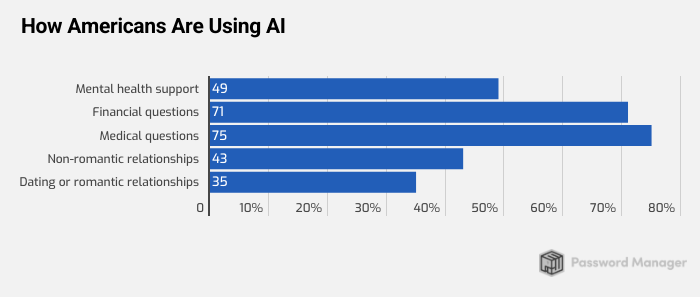
Beyond work tasks, AI chatbots have become a routine resource for some of the most personal areas of users’ lives. From financial decisions to mental health, users are turning to AI for guidance they might once have sought from a doctor, therapist, or close friend.
Thirty-eight percent of AI chatbot users say they use a work-sponsored or employer-provided AI account for personal or non-work-related conversations. Eighteen percent do so regularly.
The behavior is concentrated among younger workers and men. Sixty percent of Gen Z and 55% of Millennials say they use employer-provided AI for personal conversations, compared to 33% of Gen X and 11% of Boomers. Men (47%) are nearly twice as likely as women (28%) to do so.
The privacy implications are significant. Conversations through work-sponsored accounts are typically subject to employer monitoring and data retention policies. Users who have shared sensitive personal information through these accounts may be unaware of that exposure.
Concern about AI privacy is widespread. Seventy-seven percent of users say they are at least somewhat concerned about the privacy of their AI chatbot conversations, and 38% say they are very or extremely concerned.
Concern is not translating into action for a large share of users. Thirty-two percent say they have taken none of the protective steps mentioned below.
Security perception compounds the concern. Just 16% of users believe their AI chat history is very secure, and 33% say it is not very secure or not secure at all. Password habits reflect the same gap: just 16% use a much stronger password for their AI account than for other accounts, 21% use no password at all, and 39% say they have rarely or never changed their AI chatbot password.

77% of users say they’re concerned about AI chatbot privacy, but 32% have taken no protective steps at all. Is that gap surprising to you, and what do you think explains why privacy anxiety isn’t translating into protective behavior?
Seventeen percent of AI chatbot users say someone has already accessed their chat history without permission. Younger users and men are disproportionately affected: 33% of Gen Z and 26% of Millennials report unauthorized access, compared to 12% of Gen X and 3% of Boomers. Men (23%) are more than twice as likely as women (10%) to say their history was accessed.
The most common sources of unauthorized access: a romantic partner or spouse (8%), a friend (7%), a family member (6%), a coworker or employer (3%), and law enforcement or a government entity (1%).
The most common paths of access: a guessed or obtained password (30% of those affected), a shared or work device where the user was still logged in (27%), an unlocked device (15%), and a data breach or hack (12%).
Among the respondents who experienced unauthorized access, the consequences were significant:
Our data shows that 1 in 6 AI chatbot users say their history has already been accessed without permission, with the most common vectors being password compromise and shared devices. From a security standpoint, how significant is that figure, and what does it tell us about how people are managing access to their AI accounts compared to other sensitive accounts?
This survey was conducted in March 2026 by PasswordManager.com via Pollfish. The survey included 1,250 U.S. adults who reported using an AI chatbot (such as ChatGPT, Claude, Gemini, or Copilot) in the past month. Pollfish uses Random Device Engagement (RDE) methodology and applies quality controls including attention checks, speed checks, duplicate-response prevention, and device-level fraud detection. The survey also included a red herring attention-check question to identify and remove inattentive respondents.
Media inquiries can be directed to [email protected].